
Getting Huntington County Court Records
Begin at MyCase. That docket search will surface the case number, the court, the case type, its status, and whatever CCS entries are visible to the public. The court codes matter here: Huntington Circuit Court is 35C01, and Huntington Superior Court is 35D01. Jot both down before you go any further.
For the ordinary Circuit and Superior case file, the Huntington County Clerk is the office to contact. The clerk holds copies, judgments, traffic and criminal records, small claims, and probate-related records. Online access is the fastest route, but it is not the only one. Use whichever channel fits the item you need.
- Search MyCase and record the exact court and case number.
- Check visible CCS events and public document links.
- Call the Clerk at (260) 358-4817 to confirm custody, access, fee, and format.
- Inspect or request the file at Room 201, 201 N Jefferson St, Huntington, during posted clerk hours.
- Ask whether mail or fax at (260) 358-4880 is accepted before sending a request.
- Use the county APRA form only for county administrative material, not as a shortcut around court access rules.
In person, a public terminal at the courthouse is the offline search option. The clerk does not offer email or remote delivery of searches, so plan a visit for anything the terminal cannot reach.
Huntington County Clerk Record Desk
The elected Huntington County Clerk is Shelley M. Septer. Her official Clerk page lists Room 201, 201 N Jefferson St, Huntington, Indiana 46750. Office hours run weekdays from 8:00 a.m. to 4:30 p.m. The county page posts (260) 358-4817. A state directory shows a different last two digits. So trust the county page and confirm the number before driving over.
Huntington County Clerk
Shelley M. Septer
201 N Jefferson St, Room 201
Huntington, IN 46750
(260) 358-4817
Fax: (260) 358-4880
Monday through Friday, 8:00 a.m. to 4:30 p.m.
The clerk's desk finds and copies the public file. The Circuit and Superior court offices handle judicial proceedings, and a court reporter handles transcripts.
Court Record Types
A Huntington County court record is bigger than the online docket. The CCS is the chronological index. Behind it sits the document layer: complaints, petitions, answers, motions, notices, affidavits, and orders. Financial entries track costs, fines, fees, bonds, and payments. MyCase cautions that online figures may lag.
- Chronological Case Summary and setting history
- Public pleadings, motions, notices, and orders
- Judgment, disposition, and sentencing documents
- Current financial or payment record from the clerk
- Court reporter recordings and transcripts
- Exhibits and original papers held under court rules
- Public redacted copies when protected data is removed
Administrative records are a different animal. Fee schedules, reports, budgets, and meeting records do not belong to any one case file, so they travel through the county's records-request channel instead.
CCS vs Huntington County File
Indiana calls its docket the CCS. It logs the date and nature of filings, events, settings, rulings, and dispositions. It will not show every attachment, and a MyCase printout is not a certified copy.
| Record layer | What it answers | Usual custodian |
|---|---|---|
| CCS | What happened and when | Clerk / MyCase public view |
| Filed document | What a motion, order, or pleading says | Clerk, subject to access rules |
| Transcript | What was said in a proceeding | Court reporter / court |
| Exhibit or original | Evidence or original item retained in custody | Court or reporter as directed |
| Administrative record | How a public office operated | County department or other agency |
Local Huntington rules bar removing originals without an order and a receipt. So asking for "the whole docket" can slow things down. Name the layer you need and the exact entry date.
Inside a Huntington County Court Record
A good request names the case and the item, not just a party. That detail lets Room 201 pull the right file fast. It also tells staff whether the item is public, redacted, in-person only, or held elsewhere.
| Case identifier | Court code, year, classification, and sequence. |
|---|---|
| Caption and role | Public title and each party's place in the case. |
| Filed date and status | When the matter began and whether it remains open. |
| CCS entry | Dated action, setting, filing, order, or disposition. |
| Document link | Online copy only where the access matrix permits. |
| Restriction marker | Seal, exclusion, redaction, or unavailable-online condition. |
| Financial line | Online figure that needs clerk confirmation if current amount matters. |
Find the full filing history through the Huntington County case lookup first. Then request the item by case number at the clerk's desk.
Missing Huntington County Documents
A MyCase result with no document link does not mean the document is sealed. It may be public only at the courthouse. It may predate online imaging, sit unscanned in the file, or belong to a reporter or exhibit file. Access also varies by case type under the official access matrix. The state's MyCase search source shows the help channel for pinning down the right case. Do that before you ask about a missing document.
Once you have the case number, ask the clerk what comes next: inspection, a redacted copy, or a formal access request. The clerk will point to the proper route.
Fees and Certified Copies
Huntington County publishes no complete current fee schedule for court copies. The ePay ticket-copy amount applies to tickets only. Before filing a broad request, call Room 201 for the current charge, accepted payment, delivery method, certification, and timing.
| Item | Published amount | Action |
|---|---|---|
| Plain court-file copy | Not stated in reviewed county sources | Confirm with Clerk |
| Certified court copy | Not stated | Ask for certification and total |
| Transcript | Not stated | Ask court reporter for process |
| ePay ticket copy, when available | $1.00 | Traffic portal item only |
A certified copy is a clerk copy with an authentication. That sets it apart from a plain printout and from a transcript. State courts may collect only authorized costs and fees.
Huntington County Statistics Are Separate
ICOR and the annual judicial reports count filings, dispositions, staffing, and finances. They cannot return the record of a named case. The Indiana trial statistics source illustrates that separate public-data layer.
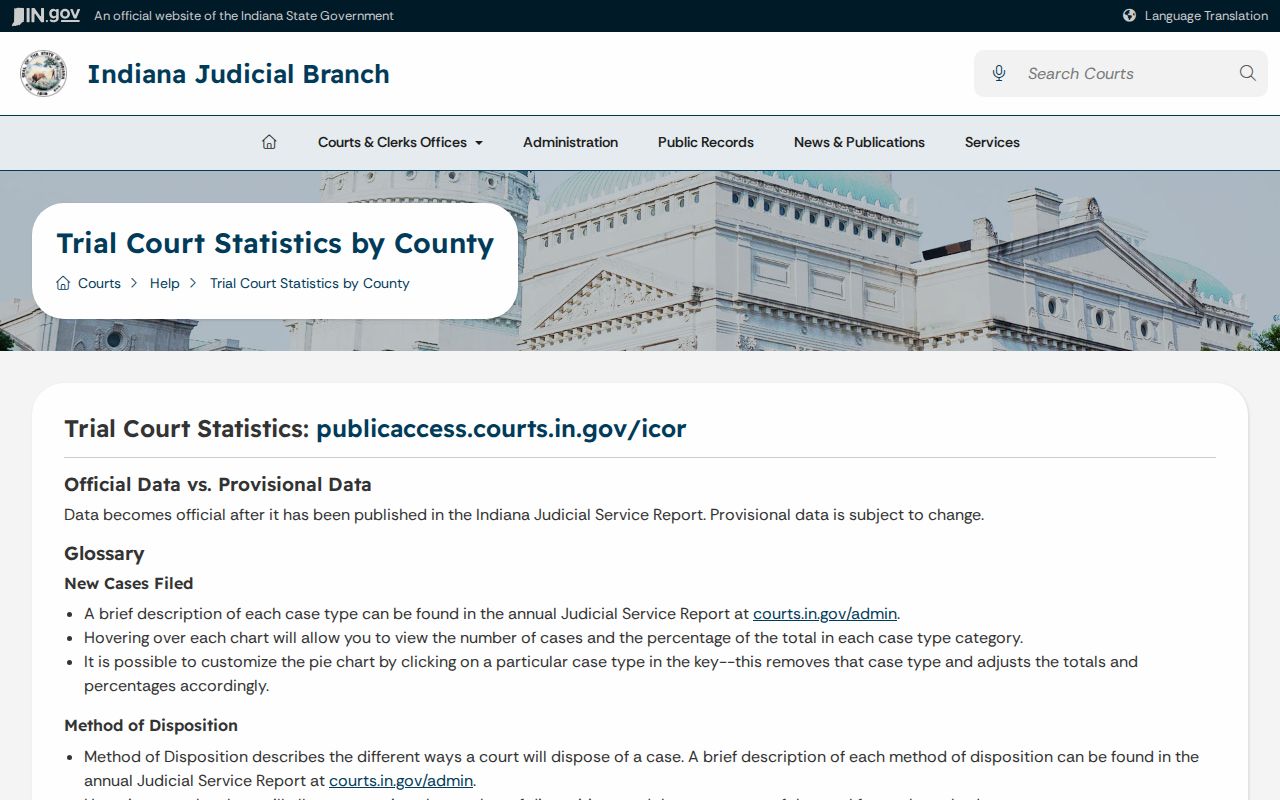
Statistics explain court activity, but only the clerk's case file yields an official Huntington County court record. The PACER source, by contrast, covers federal records only.
PACER serves federal district, bankruptcy, and appellate files, not Huntington Circuit or Superior records.
Huntington County APRA Requests
Huntington County's online Access to Public Records form gathers the basics: your contact details, a date and time, a digital signature, a specific description, the department, and a choice between Inspect and Buy. The form carries a 24-hour statement about notice of disclosability. That is a notice promise, not a promise to finish copies of a complex record within a day.
APRA sits in Indiana Code 5-14-3 and covers public agency records. It does not override court confidentiality rules. So use the county form when an administrative record sits with Huntington County. But for a court filing start with the clerk and the Rules on Access to Court Records. Sealed items go through the court's Rule 9 process instead.
When you draft an administrative request, name the date range, department, document type, and subject. Pick Inspect if looking is enough; pick Buy when you need a copy. The county form also has internal staff fields. Those cover handling, attorney review, disclosure or nondisclosure, comments, and requester notice. Those fields trace a decision process. They do not promise that every responsive item is open, since a court order, privilege, or access rule can still control a judicial record.
For the court file itself, bring the case number and point to the precise CCS entry or filed document. Ask whether the clerk has custody. Or ask whether the item belongs to the court reporter, a judge, the probation office, the appellate clerk, or a federal court. That question keeps an administrative request from landing in the wrong office. It also separates a public docket entry from a restricted attachment.
Mail works as a written fallback only after the receiving office confirms its procedure. The Clerk, Circuit, and Superior offices all publish fax numbers. But a published number is not proof that a record request or filing may arrive that way. The county offers no general court-record email, dropbox, or vendor channel for this. Compiled or bulk data falls under Administrative Rule 9, not automated collection from MyCase.
Sealed Records and Public Access
Indiana Rule 1 presumes the public can access court records. Rule 5 then carves out records shielded by statute, privilege, seal, or another listed ground. Juvenile, adoption, mental-health, protection-order, expunged, and supervision material can carry strict limits. Even public copies may arrive redacted. Addresses, phone numbers, birth dates, and other confidential data can be masked.
Current framework: Rules 1, 4, 5, and 9 govern court-record access; Administrative Rule 9 addresses remote, courthouse, calendar, and compiled access; APRA does not cancel a court restriction.
Access rules alone are not the whole picture. The Indiana traffic procedure source shows how a case-specific statute must be read together with those access rules before a record can be released.
If access is limited, ask for the public or redacted record and the stated legal basis. Rule 9 extraordinary access takes a verified written request and a court decision. A clerk cannot simply unseal something informally.